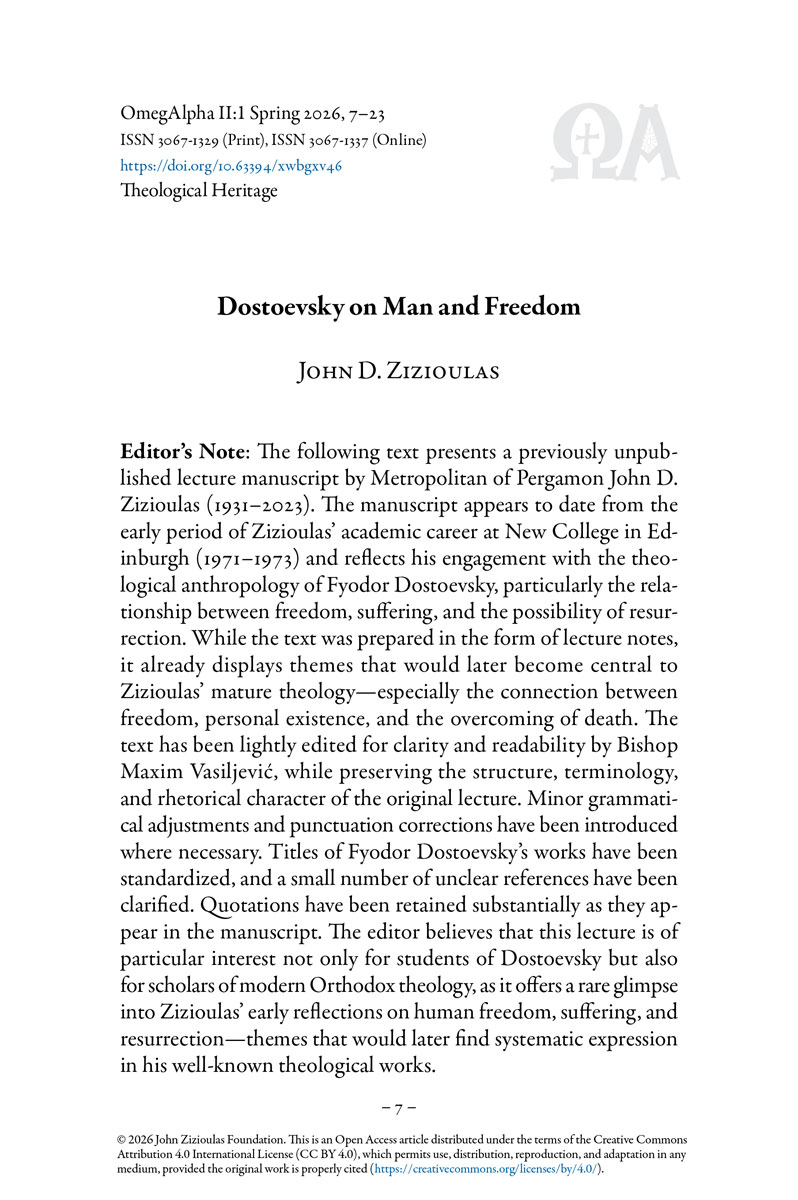
Dostoevsky on Man and Freedom
DOI:
https://doi.org/10.63394/xwbgxv46Keywords:
Dostoevsky, freedom, theological anthropology, suffering, resurrection, Christian eschatologyAbstract
This previously unpublished lecture manuscript by John D. Zizioulas examines Fyodor Dostoevsky as a theological thinker whose reflections on freedom, suffering, and death raise fundamental questions for Christian anthropology. Rather than approaching Dostoevsky primarily as a literary figure, Zizioulas interprets his novels as explorations of the existential limits of human freedom. Dostoevsky’s characters reveal a paradox at the heart of human existence: the human longing for absolute freedom confronts the reality of suffering and death. According to Zizioulas, Dostoevsky’s anthropology challenges both Western humanistic optimism and modern ideological projects that seek to eliminate suffering while preserving freedom. The lecture further explores Dostoevsky’s eschatological vision, especially as articulated in The Brothers Karamazov, where the problem of death becomes central to the future of humanity. The text offers a rare glimpse into Zizioulas’ early engagement with themes that would later become central to his theology of personhood, freedom, and resurrection.
Downloads
Published
Issue
Section
License
Copyright (c) 2026 John Zizioulas Foundation

This work is licensed under a Creative Commons Attribution 4.0 International License.