Identity, Otherness, and the Trinity

A Comment on Zizioulas’s “Logic of Identity” Notes

Authors

DOI:

https://doi.org/10.63394/b61rra96

Keywords:

Zizioulas, Trinity, divine Persons, identity, otherness, logic, numerical sameness

Abstract

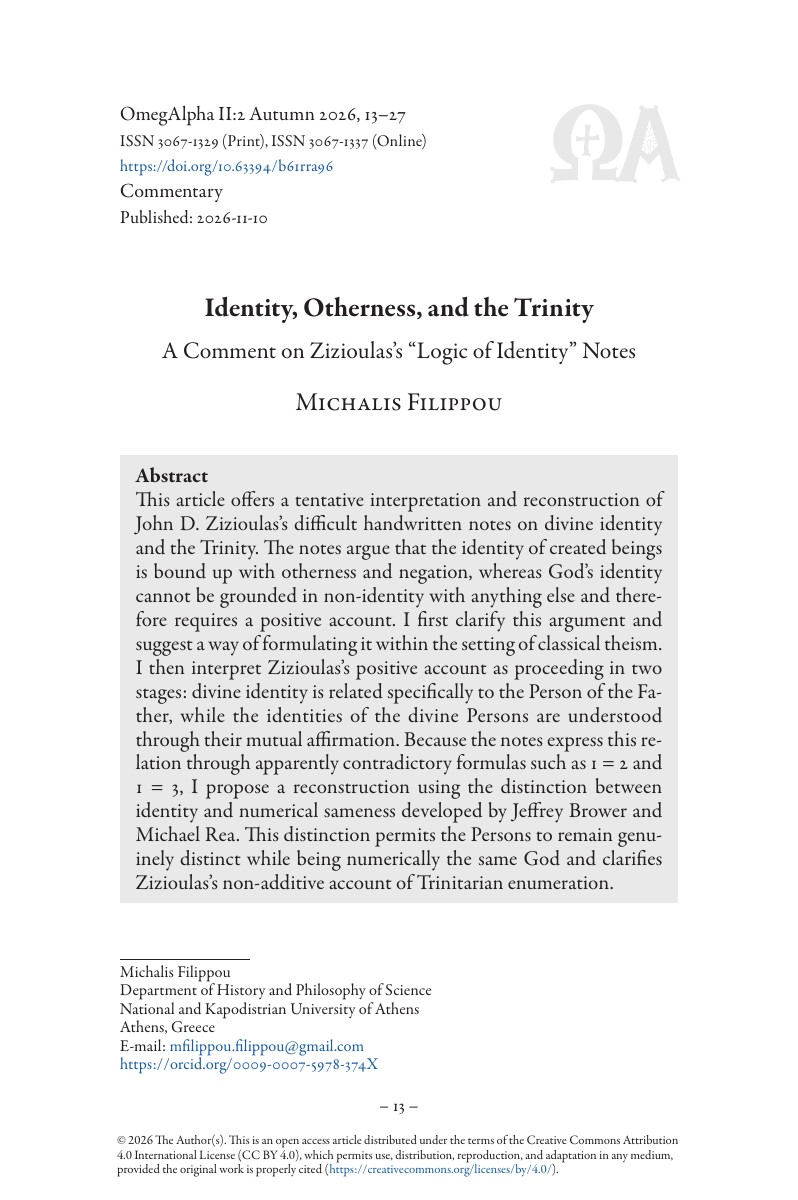
This article offers a tentative interpretation and reconstruction of John D. Zizioulas’s difficult handwritten notes on divine identity and the Trinity. The notes argue that the identity of created beings is bound up with otherness and negation, whereas God’s identity cannot be grounded in non-identity with anything else and therefore requires a positive account. I first clarify this argument and suggest a way of formulating it within the setting of classical theism. I then interpret Zizioulas’s positive account as proceeding in two stages: divine identity is related specifically to the Person of the Father, while the identities of the divine Persons are understood through their mutual affirmation. Because the notes express this relation through apparently contradictory formulas such as 1 = 2 and 1 = 3, I propose a reconstruction using the distinction between identity and numerical sameness developed by Jeffrey Brower and Michael Rea. This distinction permits the Persons to remain genuinely distinct while being numerically the same God and clarifies Zizioulas’s non-additive account of Trinitarian enumeration.

Downloads

Download data is not yet available.

Author Biography

  • Michalis Filippou, National and Kapodistrian University of Athens, Department of History and Philosophy of Science

    Michalis Filippou studied philosophy at the University of Athens and subsequently pursued postgraduate studies in philosophy at University College London, where he received an MA. He completed his PhD in Philosophy at King’s College London under the supervision of Mark Sainsbury. His doctoral research was primarily concerned with issues in philosophical logic, philosophy of language, and the philosophy of fiction. During his years in London, Filippou taught philosophy at King’s College, including courses and tutorials in logic, metaphysics, philosophy of language, epistemology, and philosophy of mind. He also developed research interests in analytic metaphysics, philosophy of religion, and medieval philosophy. In 2017, he joined the Department of History and Philosophy of Science at the National and Kapodistrian University of Athens, where he has taught ever since. His teaching and research range across philosophical logic, philosophy of language, analytic metaphysics, philosophy of religion, and medieval philosophy. He has taught both undergraduate and postgraduate courses, including courses on symbolic and philosophical logic, analytic philosophy, medieval philosophy, modal metaphysics, and the philosophy of religion. Filippou has published articles in philosophy of language, philosophical logic, philosophy of religion, and medieval philosophy, and, more recently, in metaethics. A significant part of his more recent work lies at the intersection of analytic philosophy and philosophical theology, with particular attention to the application of contemporary logical and metaphysical methods to traditional problems in philosophical theology. His broader philosophical interests include questions concerning identity, modality, metaphysical realism, fiction and fictional discourse, and the relation between analytic philosophy and historically significant philosophical and theological traditions.

References

Aquinas, Thomas. Summa contra Gentiles. Editio Leonina manualis. Apud Sedem Commissionis Leoninae et apud Librariam Vaticanam, Desclée and Herder, 1934.

Brower, Jeffrey E., and Michael C. Rea. "Material Constitution and the Trinity." Faith and Philosophy 22, no. 1 (2005): 57–76. https://doi.org/10.5840/faithphil200522134.

Garcia, R. K. "Two Ways to Particularize a Property." Journal of the American Philosophical Association 1, no. 4 (2015): 635–52. https://doi.org/10.1017/apa.2015.21.

Plato. "Sophist." Translated by Nicholas P. White. In Plato: Complete Works, edited by John M. Cooper and D. S. Hutchinson. Hackett Publishing, 1997.

Zizioulas, John D. Communion and Otherness: Further Studies in Personhood and the Church. Edited by Paul McPartlan. T&T Clark, 2006.

Zizioulas, John D. Unpublished handwritten notes on the "logic of identity." n.d.
Michalis Filippou - Identity, Otherness, and the Trinity: A Comment on Zizioulas’s “Logic of Identity” Notes

Downloads

Published

2026-11-10

How to Cite

Filippou, Michalis. 2026. “Identity, Otherness, and the Trinity: A Comment on Zizioulas’s ‘Logic of Identity’ Notes”. OmegAlpha: Journal for the Study of Metropolitan John Zizioulas’ Theology 2 (2): 13–27. https://doi.org/10.63394/b61rra96.

Similar Articles

11-20 of 28

You may also start an advanced similarity search for this article.